Washington between acts
Mount Vernon in the Eighties

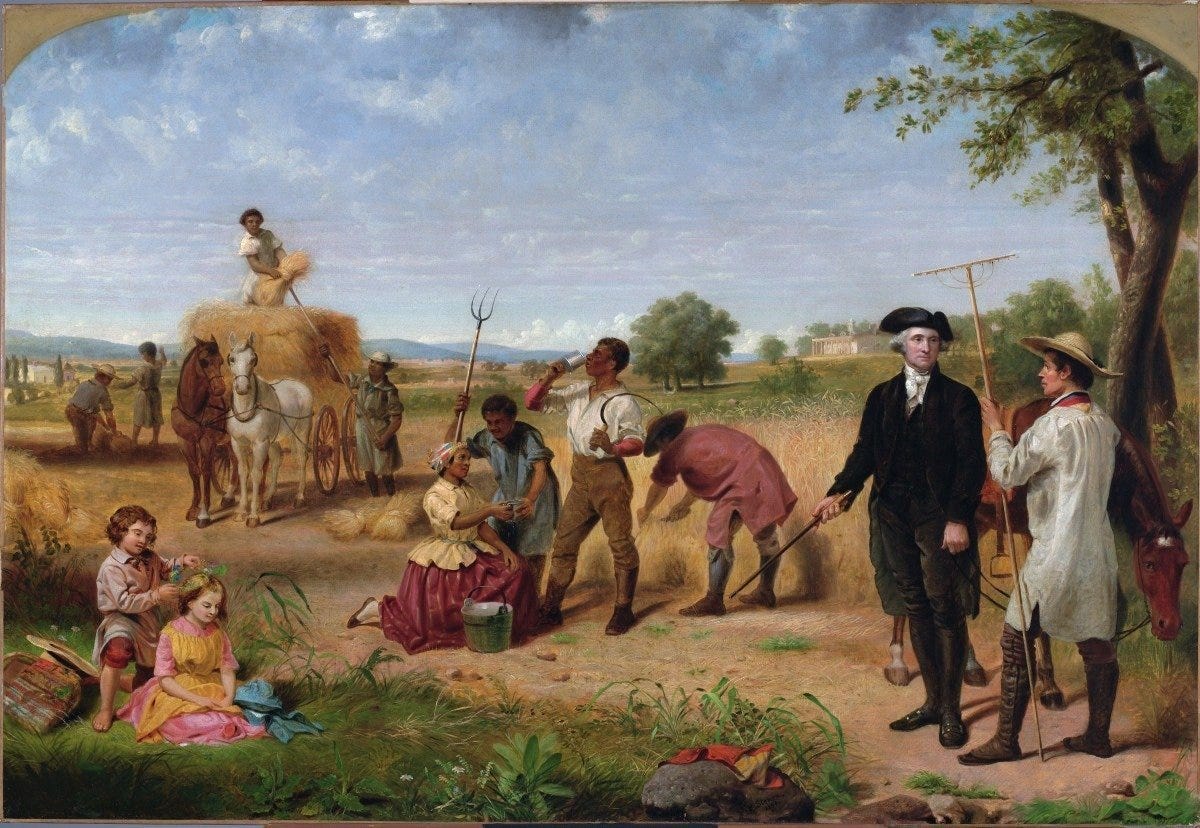
John Hunter was an English gentleman who toured the United States and Canada in 1785 and 1786. The American Revolutionary War had ended in 1783, and Hunter wanted to see how independence suited the thirteen rebel colonies and how loyalty served faithful Canada, which now contained tens of thousands of emigres from the United States.
Hunter especially wanted to see George Washington. He knew that the victorious general of the rebel army had retired from public life to his home at Mount Vernon on the Potomac River below Alexandria, Virginia. He had heard that Washington entertained guests, especially those with news of the outside world. Hunter hoped he might be welcomed.
“After breakfast I waited on Colonel Fitzgerald,” Hunter wrote in his diary for November 16, 1785. “A fire that had broke out in the town hindered us from getting off so soon as we intended. However, after some trouble it was extinguished and at half past eleven we left Alexandria with Mr. Lee, the president of Congress, his son and the servants.” Richard Henry Lee presided over the Congress established by the Articles of Confederation.
“You have a fine view of the Potomac till you enter a wood,” Hunter wrote. “A small rivulet here divides the general’s estate from the neighboring farmers. His seat breaks out beautifully upon you when you little expect, being situated upon a most elegant rising ground on the banks of the Potomac, ten miles from Alexandria.”
Hunter’s party reached Mount Vernon at one. “When Colonel Fitzgerald introduced me to the general I was struck with his noble and venerable appearance. It immediately brought to my mind the great part he had acted in the late war. The general is about six feet high, perfectly straight and well made; rather inclined to be lusty. His eyes are full and blue and seem to express an air of gravity. His nose inclines to the aqualine; his mouth small; his teeth are yet good and his cheeks indicate perfect health. His forehead is a noble one and he wears his hair turned back, without curls and quite in the officers’ style, and tied in a long queue behind. All together he makes a most noble, respectable appearance, and I really think him the first man in the world.”
Hunter’s group were part of a regular traffic to Mount Vernon. “People come to see him here from all parts of the world,” Hunter wrote. “Hardly a day passes without visitors.”
The guests were worked into the routine. “The general seldom makes his appearance before dinner, employing the morning to write his letters and superintend his farm.” The letters were many. “It’s astonishing the packets of letters that daily come for him, from all parts of the world, which employ him most of the morning to answer, and his secretary Mr. Shaw (an acquaintance of mine) to copy and arrange.” Washington took pride in his side of the correspondence. “The general is remarked for writing the most elegant letters.”
Washington also took pride in his appearance. “When I was first introduced to him he was neatly dressed in a plain blue coat, white cashmere waistcoat, and black breeches and boots, as he came from his farm. After having sat with us some time he retired and sent in his lady, a most agreeable woman about fifty.”
Hunter and Fitzgerald spoke with Martha Washington for half an hour while Washington dressed for dinner. “The general came in again, with his hair neatly powdered, a clean shirt on, a new plain drab”—grayish brown—“coat, white waistcoat and white silk stockings. At three, dinner was on table, and we were shown by the general into another room, where everything was set off with peculiar taste, and at the same time very neat and plain.”
Washington was a convivial host. “The general sent the bottle about pretty freely after dinner, and gave success to the navigation of the Potomac for his toast, which he has very much at heart.” Washington was part of an enterprise that aimed to build a canal and locks around the Great Falls of the Potomac to open the country beyond to commercial shipping.
From what Fitzgerald had told him, and what Washington’s conversation conveyed, Hunter formed an impression of Washington’s approach to life. “He never undertakes anything without having first well considered of it and consulted different people, but when once he has begun anything, no obstacle or difficulty can come in his way but what he is determined to surmount. The general’s character seems to be a prudent but a very persevering one.”
Hunter and Fitzgerald had intended to return to Alexandria after dinner, but Washington wouldn’t hear of it. “The general absolutely insisted upon our staying on account of the bad afternoon,” Hunter wrote. “I could not refuse the pressing and kind invitation of so great a general, though our greatest enemy.” Hunter hadn’t quite forgotten the war.
Washington usually retired at nine but made an exception for this day’s group. “We had a very elegant supper about that time. The general with a few glasses of champagne got quite merry, and being with his intimate friends laughed and talked a good deal. Before strangers he is generally very reserved, and seldom says a word. I was fortunate in being in his company with his particular acquaintances. I am told during the war he was never seen to smile. The care indeed of such an army was almost enough to make anybody thoughtful and grave. No man but the general could have kept the army together without victuals or clothes; they placed a confidence in him that they would have had in no other person.”
The conversation lasted till midnight. “At twelve I had the honor of being lighted up to my bedroom by the general himself.”
The next morning Hunter saw Washington at the work he loved best. “I rose early and took a walk about the general’s grounds, which are really beautifully laid out. He has about 4,000 acres well cultivated and tends the whole himself. Indeed his greatest pride now is to be thought the first farmer in America. He is quite a Cincinnatus, and often works with his men himself—strips off his coat and labors like a common man. The general has a great turn for mechanics. It’s astonishing with what niceness he directs everything in the building way, condescending even to measure the things himself, that all may be perfectly uniform.”
This being Virginia, Washington had slaves. “The general has some hundreds of negroes on his plantations.” Mount Vernon was a village unto itself. “It’s astonishing what a number of small houses the general has upon his estate for his different workman and megroes to live in. He has everything within himself—carpenters, bricklayers, brewers, blacksmiths, bakers, etc., etc., and even has a well assorted store for the use of his family and servants.”
The stables housed Washington’s horses, including two favorites. “Among an amazing number of horses I saw old Nelson, now twenty-two years of age, that carried the general almost always during the war. Blueskin, another fine old horse next to him, now and then had that honor.” The two animals had earned their rest. “The general makes no manner of use of them now; he keeps them in a nice stable where they feed away at their ease for their past services.”
In the late morning of the second day, Hunter and Fitzgerald took their leave. Hunter conveyed his appreciation for Washington’s hospitality and concern. “I shook him hard by the hand and wished him all happiness.”
Nice read. Thank you.
Thank you for sharing.