Until the levee breaks
Rivers and foreign policy

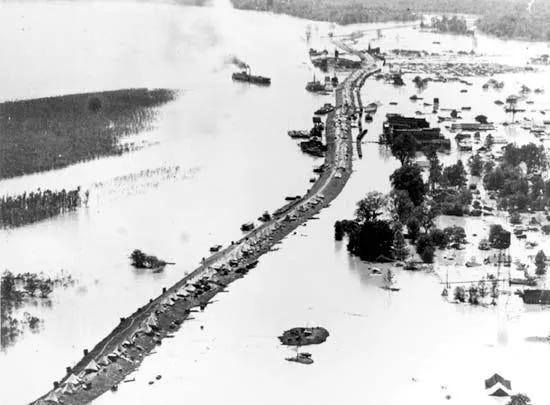
For ages, the Mississippi River has been building a delta at its mouth. The river carries silt downstream, and as the current slackens where the river meets the Gulf of Mexico, the silt sinks to the river bottom. Over time the bottom rises until the river channel is no longer the lowest point in the vicinity. The river spills over its banks and forms a new channel. The process repeats many times over many thousands of years.
For most of that period the river's wanderings have been a matter of comparative indifference to the creatures living along the riverbanks. The river moved and they moved.
Eventually, though, people built cities, which are not conveniently movable. At this point some of the river's neighbors, in particular the residents of New Orleans, took amiss the idea that the river might wander off.
In 1927 a flood on the river caused the development of an incipient new main channel, along the path of the Atchafalaya River, a lesser channel to the Gulf.
This would have been very disruptive to the lives of the people of New Orleans, who successfully lobbied the federal government to take responsibility for keeping the Mississippi within its previous banks. The government gave the task to the Army Corps of Engineers, who have spent the last century doing what was asked.
The job grows increasingly difficult and expensive. The silt keeps coming down the river and raising the riverbed. Containing the river requires heightening the levees along the banks of the river. By now the surface of the river is many feet above the land behind the levees, lending the impression that boats and barges on the river are gliding through the air.
As long as the political will persists and the money keeps flowing, the Mississippi can probably be made to go where the interested parties want it to go. But should politics become distracted and the necessary investment fall short, the river will resume its natural ways, perhaps with great loss of human life and property. Hurricane Katrina in 2005 gave a taste of what would be involved.
Should the worst happen, some will say it was hubris that caused humans to think they could override gravity and other forces of nature. Some already do say that.
Perhaps it is hubris, but it's the kind of thing we humans do all the time. We defy gravity whenever we fly in a plane. We populate deserts with cities that require constant large inputs of water and electricity. Most people today live far from the farms that feed them. Should intricate supply chains fail, those people will go hungry.
We defy gravity in our political arrangements as well. During the last eight decades America has built and maintained an international order not unlike the levee system of the Mississippi. At first the goal was to contain the Soviet Union. The levees held long enough to produce the collapse of the Kremlin's communist empire.
More than a few Americans proclaimed that the levees had served their purpose and no longer needed to be maintained. Others, however, spied a new threat in China. The levee system was extended in China’s direction. Russia reemerged as a threat, and the old parts of the system were shored up.
Many Americans, perhaps most, hoped the levees wouldn’t have to last forever. The river would become accustomed to its channel and lose its wandering instincts. The constant maintenance could end. Americans could finally rest in a world at equilibrium.
Little evidence supported this hope. The river hadn’t changed. Americans might stop maintaining the levees, but they’d have to give the river room to roam, as it had before the levees were built. Cities and homes along the river would have to be abandoned.
This was hard counsel. But eight decades, the life of these levees, is a long time. Levees aren't the only things that have to be paid for. Compared with those other things, how important is river frontage really? Maybe we can live with floods now and then, as long as we’ve gotten out of the way.
Levees serve a purpose. But once you build them, you’re committed.
Forever?
Nothing is forever.
These daily doses of historically proven reality should be welcomed by all Americans. Sadly, most have come to expect that they can have it all at no expense, and that they don’t only because some “others” (who are, of course, unworthy) have unfairly taken it from them.