Twin peaks
The two ages of capitalist ascendancy

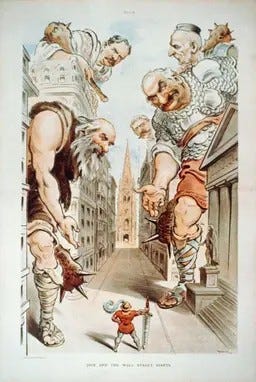
The two institutions that most characterize modern America, democracy and capitalism, emerged in the 19th century from seeds planted in 1776. Thomas Jefferson's Declaration of Independence gave rise to democracy. Adam Smith's Wealth of Nations provided the blueprint for capitalism.
Democracy took hold in the first half of the 19th century. The elimination of property requirements for voting produced a broad franchise by the 1820s. The election of Andrew Jackson in 1828 signaled the arrival of a popular culture of democracy, which became the political culture of America.
Capitalism first flourished in the second half of the 19th century, as the industrial revolution took hold during and after the Civil War. New techniques of production gave rise to innovations in finance. By the 1890s large corporations called trusts dominated dozens of sectors of the economy.
In some respects, democracy and capitalism are complementary. Each emphasizes individual rights: democracy in the political sphere, capitalism in the economic sphere.
In other respects, they are rivalrous. The fundamental value of democracy is equality. Each voter brings one vote to the ballot box, no more and no less. The engine of capitalism is inequality. People bring unequal talents and resources to the marketplace, which rewards them unequally.
In a free society, wealth can influence politics. The wealthy have greater access to political office and to those who hold political office. In America in the late 19th century, the era known as the Gilded Age, the Senate was dubbed the Millionaires Club for the moguls who bribed state legislatures to elect them. Unsurprisingly, laws tended to favor the interests of the capitalists.
Moreover, capitalism possesses a dynamism denied to democracy. In pursuit of those unequal rewards, manufacturers and financiers devise novel methods of production and accumulation. Officials of democracy desiring to restrain capitalism are at a constant disadvantage, always taking aim at a moving target.
As a result, by the end of the 19th century capitalism dominated the landscape of the American political economy. The most powerful men in America were not presidents or senators or judges, but the great capitalists. A telling incident occurred in 1895 when financier J. P. Morgan rescued the United States treasury from default.
As things happened, the turn of the 20th century marked a high point in the comparative influence of capitalism vis-a-vis democracy. After achieving this peak, capitalism's advantage declined under the onslaught of democratic reforms of the progressive era. Railroads and other large corporations were regulated by government as never before. The biggest trusts were broken up by court rulings. The creation of the Federal Reserve shifted control of the money supply from Wall Street to Washington. The Millionaires Club dissolved when the 17th Amendment mandated popular elections for the Senate. The New Deal reforms of the 1930s threw additional regulatory restraints around the institutions of capitalism.
The capitalists never liked the restraints. Over time, other Americans disliked them too. They raised the costs of air travel and transport. They stifled innovation. The regulatory state grew clumsy and expensive.
Republicans campaigned to reduce regulations and set capitalism free. Ronald Reagan was elected president in 1980 on this platform. In his first inaugural address, he took a memorable swipe at democracy, saying that government was no longer the solution to America's problems but the problem itself.
The three generations during which democracy caught up with capitalism have been followed by two generations of renewed capitalist ascendancy. The current era of laissez faire has seen the amassing of corporate and personal fortunes vaster than any of the Gilded Age.
The capitalist reconquista was most evident during the first months of Donald Trump's second term. At his second inauguration, the billionaire president was flanked by the centibillionaires who run the trillion-dollar firms that dominate the tech world. Trump delegated direction of the executive branch to Elon Musk, the wealthiest person on the planet.
Whether this represents the highest point of the new era of capitalism remains to be seen. A peak is never identified for certain till you can see down the other side.
Yet there's reason to believe that the current enthusiasm for artificial intelligence has overvalued the big firms chasing the holy grail of the uber bot smarter than us all.
When the correction occurs, democracy will have its chance to catch up once again.
Interesting tension you set up between the two primary forces of the American system (there may be others). Maintaining dynamic equilibrium between the two seems to be a sweet spot, allowing neither to gain too great an ascendancy and trigger a cycle of diminishing and even reversing returns. On one hand, radical inequality (and the erosion of the massive middle class), hampers broad-based economic growth. On the other, excessive regulation stifles innovation and the basis of future growth. (Is democracy necessarily characterized by regulation in a bloated administrative state?). I guess that’s why we elect such wise political leaders, to help us find the balance.
JP Morgan also wrangled other millionaires during the Panic of 1907- acting as a defacto Federal Reserve before we had one.
American has become an oligarchy and kleptocracy of billionaires since 1981 which accelerated under Trump.