
By design of the Constitution, the legislative and executive branches of the federal government are potentially at odds. The president can veto acts of Congress, and Congress can override presidential vetoes. During war, power shifts toward the west end of Pennsylvania Avenue. Presidents are commanders in chief, and the necessities of war override the niceties of peacetime politics. During the Civil War, Abraham Lincoln became the most powerful president in American history. With the stroke of his pen in signing the Emancipation Proclamation, Lincoln cut the gordian knot of slavery that had defied decades of resolving attempts by all three branches of government. In the process, he wiped out $4 billion of slaveholder wealth.
The end of the war would have witnessed efforts by Congress to claw back power it had lost to the president, regardless of who the president was. Lincoln, bolstered by the prestige of having saved the Union, would have had a fighting chance to resist the restorative efforts. Andrew Johnson had no such prestige and almost no chance of resistance.
Sherman’s surrender agreement with Joe Johnston reached Washington just as Congress was beginning to appreciate its unexpected advantage vis a vis the new president. “If you will get the president simply to endorse the copy . . . ,” Sherman had written in his cover letter to Ulysses Grant. There was going to be nothing simple about it. The many people in Washington who resented the ascendance of Andrew Johnson and were determined to prevent his picking up where Lincoln left off would make ending the war anything but simple.
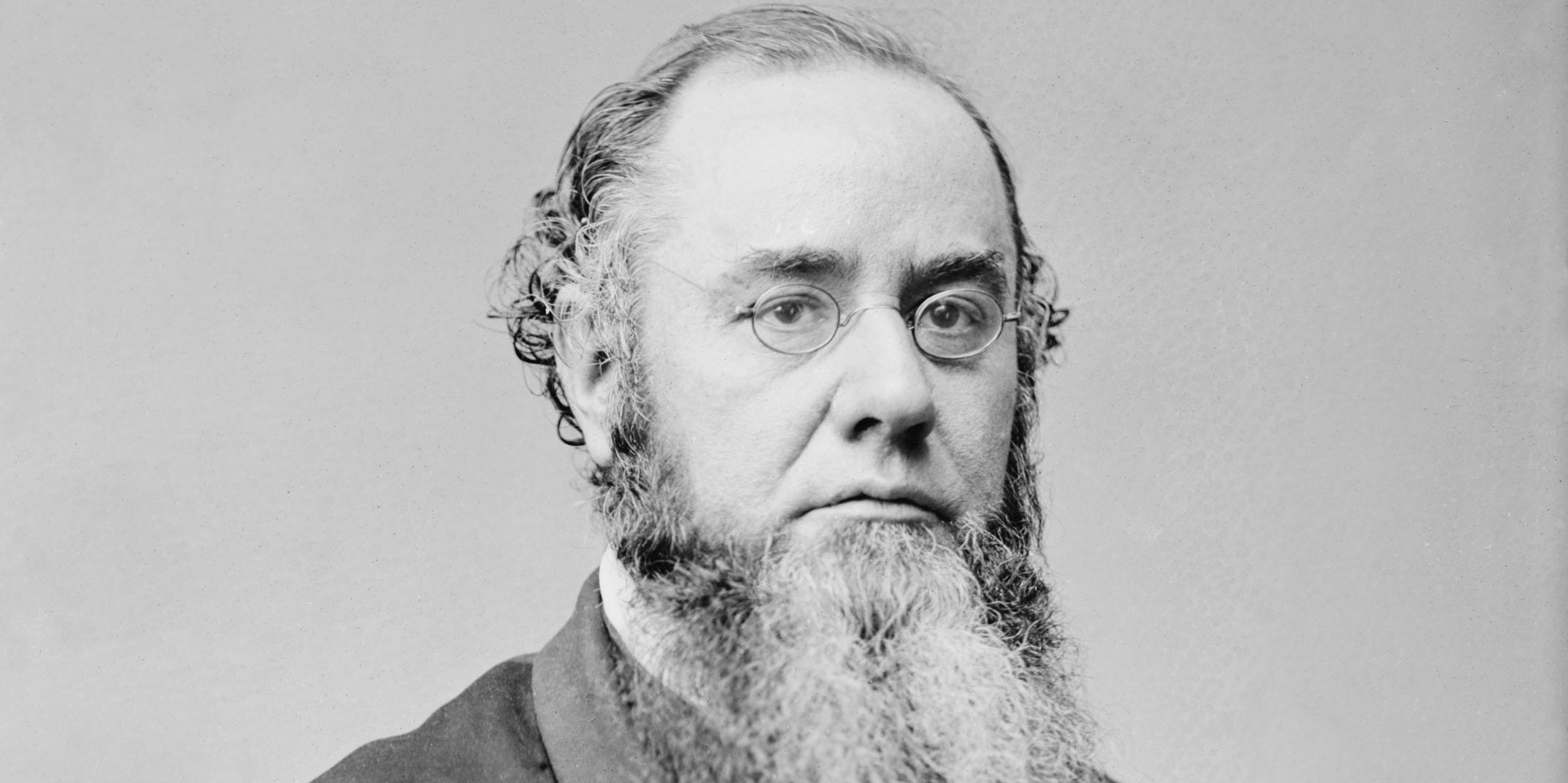
Edwin Stanton was one of those. The secretary of war knew that Sherman despised him for contributing to the belief that Sherman had gone crazy for a moment early in the war. Stanton reciprocated the ill feeling. But Sherman’s success in the field had kept Stanton from acting on his feeling. Now, though, Sherman had stepped out of his area of military expertise into the more complicated realm of politics. Stanton saw his opportunity to discredit Sherman even while stymieing a quick resolution of the war by Andrew Johnson.
A few days after sending his draft to Washington—in confidence, he assumed—Sherman saw a copy of the New York Times with an article headlined “Gen. Sherman’s Extraordinary Negotiation for Peace.” The author of the article obviously had seen Sherman’s draft. “The loyal public will read with profound surprise the terms which Gen. SHERMAN tendered to the rebel government, as represented by its only uncaptured commander, Gen. JOHNSTON, as the basis of peace. In reading the provisions of this remarkable compact—which was signed on the 18th of April, four days after the assassination of President LINCOLN—one is at a loss to know which side agreed to surrender. JOHNSTON certainly could have intended nothing of the kind. He evidently believed himself to be negotiating with an equal—dictating terms, rather than receiving them—and laying the basis of a new government based on a theory of State rights as absolute and complete as CALHOUN ever dreamed of.”
The article proceeded to excoriate Sherman for naivete at best and disloyalty at worst. The agreement he proposed to Johnston undid all the good the Union armies had done on the battlefield, the article said. “It changes, at one stroke, the whole policy of the National Government. It substitutes for the formal resolutions of Congress, and the solemn decisions of the National Executive, the compromises of a military subordinate with a rebel leader. It carries the nation back to the very source and fountain of the calamities which were sprung upon it when the gage of battle was first thrown down by the conspirators.”
The article concluded that Sherman might be in league with Jefferson Davis himself. “We fear that this most unfortunate step of Gen. SHERMAN has already led to results of serious detriment to the national cause. It has probably allowed DAVIS and BRECKINRIDGE”—John Breckinridge was the Confederate secretary of war—“with their prominent and responsible confederates in the rebellion, to secure their personal safety, and there is some reason also to apprehend that it may have allowed JOHNSTON to remove his army beyond the immediate reach of his late antagonist.”
Sherman assumed Stanton was behind the leak to the press. His assumption was effectively confirmed by another article in the Times, which reproduced a memorandum Stanton had circulated within the administration. “The orders of General Sherman to General Stoneman, to withdraw from Salisbury and join him, will probably open the way for Davis to escape to Mexico or Europe with his plunder, which is reported to be very large, including not only the plunder of the Richmond banks, but previous accumulations,” the Stanton memo read. “A despatch received by this department says: ‘It is stated here by respectable parties that the amount of specie taken south by Jefferson Davis and his partisans is very large, including not only the plunder of the Richmond banks, but previous accumulations. They hope, it is said, to make terms with General Sherman or some other southern commander, by which they will be permitted, with their effects, including the gold plunder, to go to Mexico or Europe. Johnston’s negotiations look to that end.’”
Sherman wasn’t surprised to learn that his draft had been rejected. He knew he was on tricky ground touching political issues. He would have been surprised had it been accepted without revision. He chiefly hoped to start a conversation that might lead to an end to the war before the politics of the Lincoln succession made a straightforward resolution impossible.
Clearly he had failed. He didn’t resent that. But he did resent being slandered by Stanton. “I regarded this bulletin of Mr. Stanton as a personal and official insult,” he wrote years later.
What made things worse, those years later, was that the settlement Sherman proposed with Johnston was essentially the settlement the country achieved after a decade of Reconstruction that caused the wounds of the war to fester rather than heal. There were no treason trials. Amnesty was almost universal. The Confederate states regained their place in the Union. The prewar ruling class in the South became the post-Reconstruction ruling class.
And Congress, after tussles with the executive that included an impeachment trial of Andrew Johnson, turned to the more congenial matter of making the country rich, and themselves, too, in the grand bargain of the Gilded Age.
I always thought this was cool.
“Edwin Stanton appears in Philip K. Dick's We Can Build You in the form of a self-aware, cybernetic automaton.” How surreal is that.