
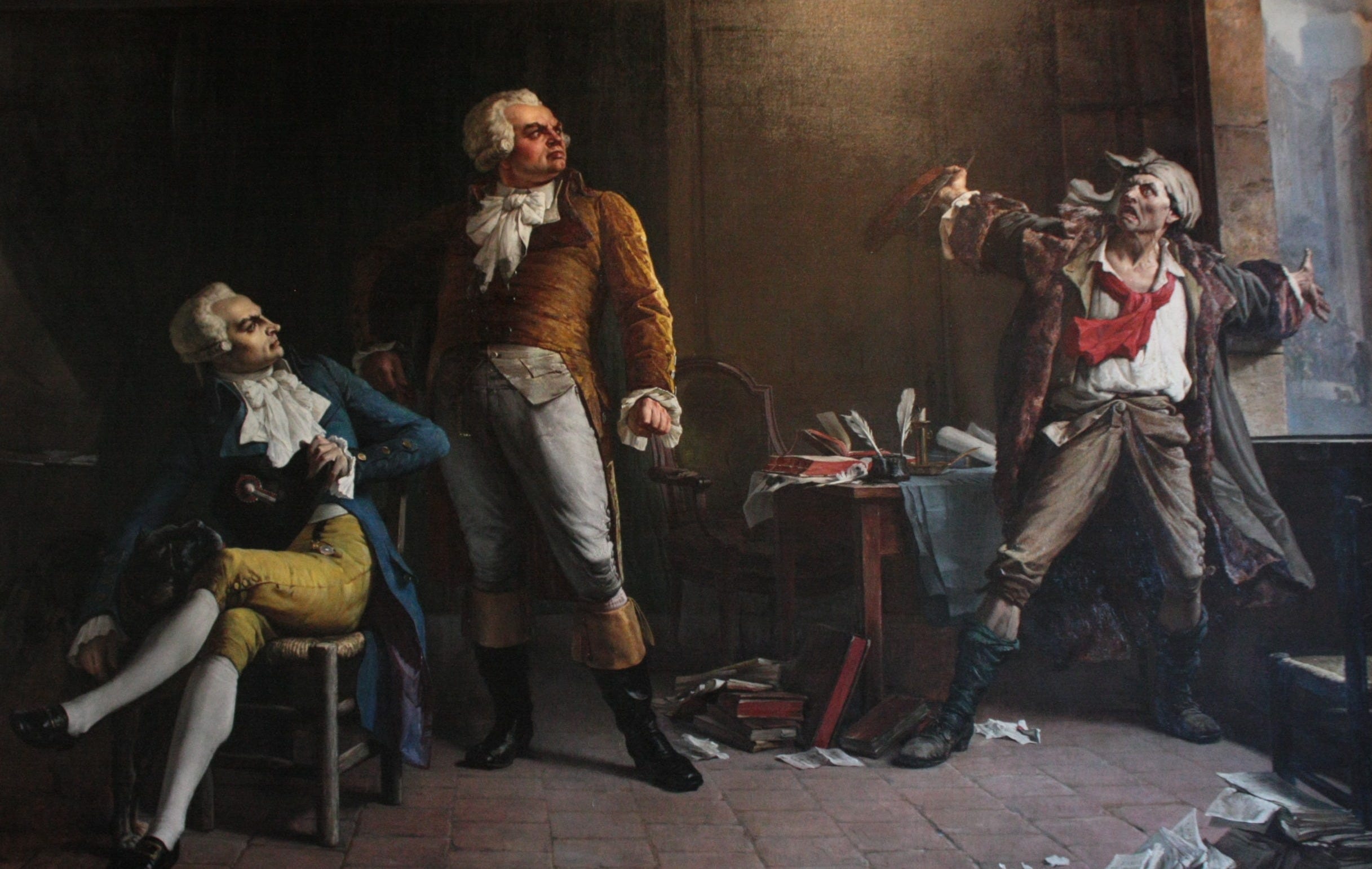
No one much heard of Georges Jacques Danton before the French Revolution. He was a Paris lawyer of small practice and modest ambition. But events of the first half 1789 stirred something within him. He gave a speech extolling freedom, and impressed listeners. He gave more speeches and attracted larger audiences. His ambitions grew. His speeches acquired rhetorical flourishes. His voice gained volume and carried farther in outdoor rallies. He came to be called “The Thunderer.”
He defended a neighbor, Jean-Paul Marat, against legal charges brought by the government. He denounced the Marquis de Lafayette, commander of the National Guard, for trampling the rights of Frenchmen.
His star rose further. With Maximilien Robespierre he took a leading role in the Jacobin Club. He was elected to office of the Paris Commune, the revolutionary government of the capital city. After King Louis XVI was deposed, Danton became minister of justice in the provisional government that followed. The outbreak of war with Austria inspired Danton to equate loyalty to the revolution with loyalty to France. “We ask that anyone refusing to give personal service or to furnish arms shall be punished with death,” he told the French assembly in 1792. He called for the boldest possible action against the enemies of cause and country. “To conquer them we must dare, dare again, always dare, and France is saved!”
Danton’s call was followed by the September massacres—the killing of more than a thousand people said to be enemies of France and the revolution. Many in Paris held him responsible. He was accused of conspiring with Marat and Robespierre to make themselves dictators of France.
In 1793 he became a charter member of the Committee of Public Safety, with broad latitude and popular support for finding and destroying the enemies of the revolution.
Yet he ruffled some of the committeemen and others in the government. He incurred suspicion by marrying a woman half his age—he was thirty-four and she seventeen—and doing so in a Catholic ceremony, at a time when the Catholic church was a staunch opponent of the revolution.
Whether from the Catholic influence or for other reasons, Danton began to question the escalating resort to judicial violence embodied in the Committee of Public Safety. He stepped away from the committee just as Robespierre was making it a vehicle for an even more radical vision of the revolution. The reign of terror would kill some fifty thousand men, women and children.
“It is right to repress the royalists,” Danton said in one exchange with Robespierre. “But we should not strike except where it is useful to the Republic. We should not confound the innocent and the guilty.”
Robespierre snapped back: “Who told you that one innocent person had perished?”
Danton left his implication hanging in the air.
Robespierre wouldn’t let it go. He deemed Danton a turncoat.
Friends urged Danton to flee for his life. “Where shall I go?” he responded. “If freed France casts me out, there are only dungeons for me elsewhere.”
One evening in the spring of 1794 he was warned that the committee had ordered his arrest. “They dare not,” he said, perhaps for the sake of appearance. He retired and went to sleep.
The next morning he was in prison.
He mused about the turn of events. “This time a year ago, I was moving the creation of that same revolutionary tribunal,” he said of the body that would try him. “I crave pardon for it of God and man.”
His efforts on behalf of France had failed, he said. “I leave the whole business in a frightful welter.” His successors were imbeciles. “Not one of them understands anything of government.” They would destroy each other. “Robespierre will follow me.” He wished he had never gone into politics. “It would have been better to be a poor fisherman than to meddle with the governing of men.”
The trial went as he expected. For the record the court required his name and abode. “My name is Danton, a name tolerably known in the Revolution,” he said. “My abode will soon be annihilation. But I shall live in the pantheon of history.”
He demanded to face those who brought charges against him. “Let them appear, these accusers of mine. I have all the clearness of my self-possession when I demand them.” Danton knew who had put them up to their accusations. “I will unmask the three shallow scoundrels who fawn on Robespierre, and lead him towards his destruction. Let them produce themselves here. I will plunge them into nothingness, out of which they ought never to have risen.”
The president of the tribunal, who seemed troubled by the task before him, tried to regain control of the proceedings. He jingled a bell and called for Danton to calm down.
“What is it to you how I defend myself?” replied Danton. “The right of dooming me is yours always. The voice of a man speaking for his honor and his life may well drown the jingling of your bell.”
The fix was in. The tribunal had its orders from Robespierre, whom the members dared not cross. They delivered the required verdict—guilty. They decreed that the sentence—death—be carried out that day.
Danton held his head high as he rode in the tumbril to the guillotine. Before he mounted the steps he was heard to say, “Oh, my wife, my well beloved, I shall never see you more!” He caught himself. “Danton, no weakness!”
One of his fellow prisoners embraced him, bringing their heads close together. Danton pointed to the headsman’s sack. “Our heads will meet there,” he said.
When his turn came, he gave a final direction to the headsman: “Show my head to the people. It is worth showing.”
Danton was right about Robespierre following him to death. The executions escalated until no one, not even Robespierre’s allies, felt safe. Several of those most fearful conspired against him and arranged his arrest. He responded with such outrage that he could hardly speak. “The blood of Danton chokes him!” said one of the conspirators. Four months after Danton, Robespierre was beheaded.
Has anyone ever seen the 1983 film “Danton” directed by Andrzej Wajda about Danton’s last weeks of his life? Is it worth watching?
Love this!