Taking advantage
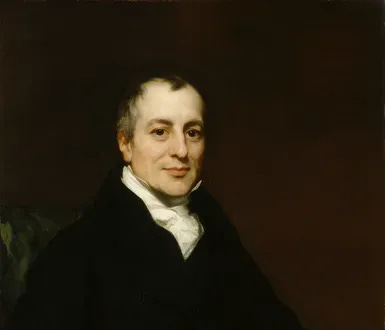
David Ricardo on why we trade

Woodrow Wilson was a faster typist than his secretary. Why didn’t he type his letters and speeches himself?
Because he could do things his secretary couldn’t, like being president. The most efficient use of his time was to do presidential stuff and let his secretary do secretarial stuff, like typing.
This question of how to make most efficient use of time and other resources lies at the heart of economics. Adam Smith in the 1776 Wealth of Nations argued that if one country was better than another at producing a certain good, and that second country was better than the first at producing another good, then trade between the two countries would leave both better off. Hence Smith’s support for free trade.
David Ricardo elaborated the idea in 1817 in On the Principles of Political Economy and Taxation. “Under a system of perfectly free commerce, each country naturally devotes its capital and labor to such employments as are most beneficial to each,” Ricardo wrote. “This pursuit of individual advantage is admirably connected with the universal good of the whole. By stimulating industry, by rewarding ingenuity, and by using most efficaciously the peculiar powers bestowed by nature, it distributes labor most effectively and most economically; while, by increasing the general mass of productions, it diffuses general benefit and binds together by one common tie of interest and intercourse the universal society of nations throughout the civilized world. It is this principle which determines that wine shall be made in France and Portugal, that corn shall be grown in America and Poland, and that hardware and other goods shall be manufactured in England.”
Ricardo became more specific. “A country possessing very considerable advantages in machinery and skill, and which may therefore be enabled to manufacture commodities with much less labor than her neighbors, may in return for such commodities import a portion of the corn required for its consumption, even if its lands were more fertile, and corn could be grown with less labor than in the country from which it was imported.”
This was a subtle point missed by Smith. The principle of comparative advantage operated even when one country was better than another in everything. That country should still produce what it was best at. Likewise the inferior country should produce what it was best at.
“Two men can both make shoes and hats, and one is superior to the other in both employments; but in making hats, he can only exceed his competitor by 1/5 or 20 percent, and in making shoes he can excel him by 1/3 or 33 percent. Will it not be for the interest of both that the superior man should employ himself exclusively in making shoes, and the inferior man in making hats?”
Yes it would be, said Ricardo. And so said nearly every other economist from Ricardo's day until the present. If the goal is the greatest prosperity for the greatest number of people, the principle of comparative advantage can't be beaten.
But economists don't rule the world. And maximum prosperity isn't everyone's goal. Hardware makers in France and America, in Ricardo's first illustration, wanted to protect their livelihoods. Some people in Britain feared dependence on American and Polish corn. Nationalists in many countries decried the ties of interest and intercourse which trade promoted.
Similar emotions exist today. They propelled Britain out of the European Union. They helped elect Donald Trump on pro-tariff promises. They continue to unravel the international free-trade regime that lifted billions of people out of poverty and played an important though indeterminate role in preventing World War III.
Economists aren't known for their charisma—although comparative advantage maybe at work here, too. An old joke says Jones went into accounting because he didn't have the charisma to be an economist.
But if economists were more popular, maybe their ideas would be more popular too. Failing that, they'll have to settle for being right.