
I am lying.
Do you believe me?
What are your choices?
A. If I’m telling the truth (when I say I’m lying), then I’m lying.
B. If I’m lying (when I say I’m lying), then I’m telling the truth.
Both A and B are untenable, being self-contradictory. As there is no third option, the original statement (“I am lying”) is untenable. Precisely: it is neither true nor false.
The Greeks knew about this kind of thing. One version is “All Cretans are liars.” When spoken by an Athenian, it presents no problem. But when spoken by a Cretan, it contradicts itself.
For centuries this “liar’s paradox” was a parlor amusement. But it turned serious around the beginning of the 20th century. Mathematicians had made rapid progress during the previous couple hundred years, with Newton and Leibniz introducing the techniques of calculus and their successors elaborating them. The new approach unlocked secrets of the universe, making possible modern physics.
The physicists were delighted, but some of the mathematicians were nervous. Physics and the other natural sciences had a method for testing theories: the scientific method. A hypothesis was proposed. Experiments were conducted. Each experiment that confirmed the hypothesis added weight to the underlying theory. No theory was ever proven beyond doubt. Future experiments might disprove it. But physicists were willing to live in the ever-tentative but advancing present.
Mathematicians were a different breed. They were absolutists. They insisted on proving theories—theorems—beyond the possibility of disproof. The Pythagorean theorem, once proven, applied to all right triangles whatsoever, forever. The square of the hypotenuse is always equal, exactly, to the sum of the squares of the sides.
The mathematicians took their cues from Euclid, an Alexandrian geometer of the 3rd century BC whose Elements became the template for the advance of mathematical knowledge. Euclid posited a small group of axioms, statements that seemed obviously true. To these he applied apparently indisputable rules of logical reasoning and derived theorems. These theorems were added to the knowledge base and permitted the proof of new theorems. Grand structures of mathematics arose.
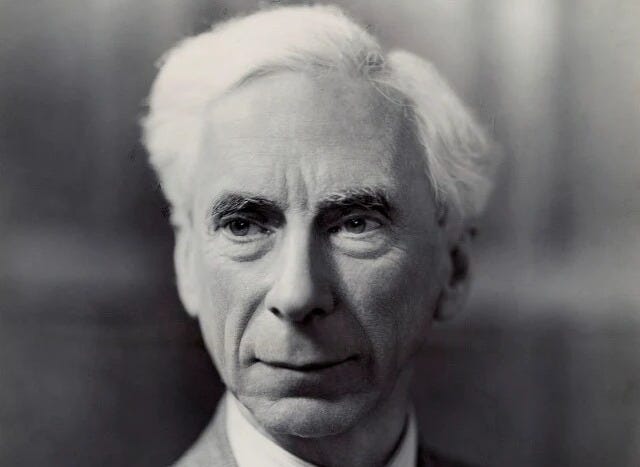
Bertrand Russell, an English mathematician and philosopher born in 1872, sought to apply Euclid’s approach to modern mathematics. Where Euclid had started with points and lines, Russell started with sets: collections of objects with certain properties in common. He began promisingly but ran into a version of the liar’s paradox.
Russell’s version was sometimes framed in terms of a village barber with a rigid rule for choosing customers. The barber shaves all the men in his village who don’t shave themselves, and only the men who don’t shave themselves.
Who shaves the barber?
If the barber (as a villager) shaves himself, then he (as the barber) does not shave that villager (namely himself).
If the barber (as a villager) does not shave himself, then he (as the barber) shaves that member of the village (namely himself).
Same contradiction as in the liar’s paradox. The barber’s rule is untenable.
The particular formulation Russell used involved sets. A set can be defined by listing its elements. The set {1, 2, 3} consists of the first three counting numbers. A set can also be defined by a rule. The set of positive even numbers less than 10 is {2, 4, 6, 8}. Sometimes the rule is handier than the listing, as for the set of even numbers less than a billion.
Sets can contain other sets as elements. {{0, 0}, {0, 1}} is the set that contains the sets {0, 0} and {0, 1} as elements.
Russell considered the set of all sets that don’t contain themselves as elements. Call it X.
Does X contain itself? This is essentially the barber paradox. If X does contain itself, then it doesn’t contain itself. If it doesn’t, it does.
The paradox dealt a blow to Russell’s dream of putting mathematics on the logical foundation of set theory. He had wanted to allow sets of any description. But a seemingly simple example involving sets that do or don’t contain themselves crashed the system.
Russell retreated. Observing the common thread of self-reference in each of the paradoxes, he ruled self-reference out of bounds in defining sets.
His problem was solved. But his theory was deprived of the elegance and power he sought.
Russell titled his magnum opus (written with Alfred North Whitehead) Principia Mathematica, after the work of the same name by Isaac Newton. But where Newton’s Principia provided the foundation for centuries of studies of the universe, Russell’s Principia gathered dust on library shelves.
Newton’s version had to be good enough to explain the real world of physics. It was until Einstein came along.
Russell’s version had to be good enough to explain the ideal world of mathematics. It had to be perfect. It wasn’t.
Other mathematicians, including Kurt Godel, would prove that nothing is perfect in the sense Russell intended. Math is hard.
In his own life Russell shaved himself. He wasn’t a barber.
On a related note, decades ago in a humanities class in an Engineering and Art school, the professor made a comment about argument, logic and debate. The bulk of the class were first year engineers. The teacher commented that if there was a debate where the proposition was "Is Calculus True" - and the side arguing against won then what? We have used it enough to know that it is true.
It was just another note about imperfection. (of course the arguments could have been faulty but let's leave that be.)
Read your article to my husband who had studied math. I gave him a set of “Principia Mathematica” as an engagement gift as he had requested. He actually worked through Vol 1. Great article.