Rapt attention
From Livy to John Ford

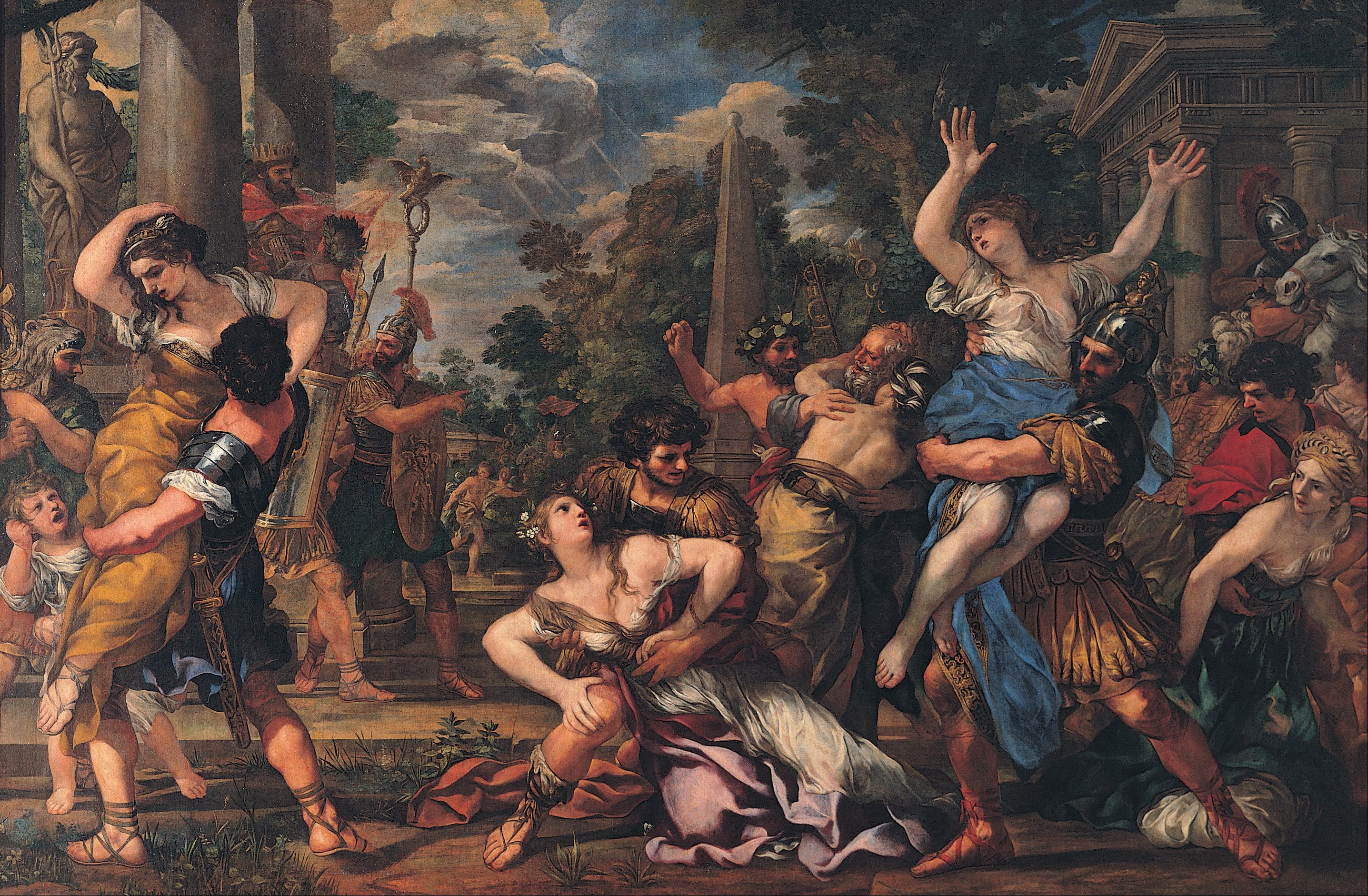
“The Roman state had now become so strong that it was a match for any of its neighbors in war, but its greatness threatened to last for only one generation, since through the absence of women there was no hope of offspring, and there was no right of intermarriage with their neighbors,” wrote the Roman historian Livy. “Acting on the advice of the senate, Romulus sent envoys amongst the surrounding nations to ask for alliance and the right of intermarriage on behalf of his new community. It was represented that cities, like everything else, sprung from the humblest beginnings, and those who were helped on by their own courage and the favor of heaven won for themselves great power and great renown. As to the origin of Rome, it was well known that whilst it had received divine assistance, courage and self-reliance were not wanting. There should, therefore, be no reluctance for men to mingle their blood with their fellow men.”
The neighbors weren’t persuaded. They saw no reason to assist the bumptious state, and certainly not by handing over their girls and young women.
The young men of Rome felt insulted that their advances were spurned. Romulus laid a plan on their behalf. He threw a festival to which all were invited. Most came, including the Sabines. Romulus wined and dined them. After they were happy and drunk he entertained them with games. “When the hour for the games had come, and their eyes and minds were alike riveted on the spectacle before them, the preconcerted signal was given and the Roman youth dashed in all directions to carry off the maidens who were present.”
The Sabine parents were understandably upset. Likewise the girls. Romulus tried to reassure the latter. “They would live in honorable wedlock, and share all their property and civil rights, and—dearest of all to human nature—would be the mothers of freemen. He begged them to lay aside their feelings of resentment and give their affections to those whom fortune had made masters of their persons. An injury had often led to reconciliation and love; they would find their husbands all the more affectionate because each would do his utmost, so far as in him lay to make up for the loss of parents and country. These arguments were reinforced by the endearments of their husbands who excused their conduct by pleading the irresistible force of their passion—a plea effective beyond all others in appealing to a woman’s nature.”
Livy’s history sometimes wandered into myth. If anything like the abduction of the Sabine women actually occurred, it probably didn’t happen quite as he related. The Romans intermarried with their neighbors, and sometimes coercion may have been involved. But it makes a better story if it happened by design.
And for future generations the story was made even better by Livy’s choice of words. When he said the maidens were carried off, the verb he used was “rapere,” which meant to seize or drag away. Centuries later, when it entered English, it produced cognates “rape” and “rapt.” The abduction was often called “the rape of the Sabine women,” and with that connotation it became a fixture of Western art.
From time out of mind, humans have been stealing other humans and compelling them to do what they didn’t choose on their own to do. Slavery was the most conspicuous form of this coercive traffic. But there were other versions. Serfs were slaves attached to land. Peasants were compelled by corvee laws to work for local headmen. Soldiers were conscripted into armies—and still are.
But the stealing of women and girls has occupied a special—and specially sensitive—spot in the human imagination. The pain to all concerned is bad enough when actual rape is the immediate object. But the poignancy is greater when the young women become assimilated into the tribes and clans that took them.
Romulus’s pitch to the Sabine maidens, if it happened, could indeed have been sincere. Tribes stole women and girls because they lacked females of their own. They sought mothers, not conquests. They had reason to treat the captives well, for the captives represented the tribes’ future.
Theft of women was common among the Indians of North America after the arrival of Europeans. Introduced disease ravaged tribal numbers. Some tribes assimilated wholly into neighboring tribes and by that means gave their young men access to young women. Other tribes staged raids on neighbors, including whites living on the frontier.
As the abduction of the Sabine women formed a part of Rome’s foundational story, so the abduction of Cynthia Ann Parker shaped the early history of American Texas. The Parker family moved from Illinois to Texas and was living at the edge of Comanche country in 1836 when Comanche raiders carried Cynthia off. She was about nine years old.
She was held captive at first but in time became a member of the tribe. She married a Comanche chief, Peta Nocona, and bore a son, Quanah, who became the greatest of Comanche war chiefs, fighting especially against the whites.
All the while, relatives and other whites refused to believe she was no longer a prisoner. Finally, twenty-four years after her abduction, she was kidnaped again, but this time by Texas Rangers. She tried to escape and return to her Comanche family but was repeatedly prevented. She died in exile from her Comanche home.
Every Texan knew the story of Cynthia Parker. Opinions differed on where sympathy should lie.
The story eventually came to the attention of filmmaker John Ford, who crafted its themes into The Searchers, the 1956 epic that is generally accounted one of Hollywood’s best. At the end of the movie, Ford transfers the ambivalence to the broad shoulders of John Wayne, who delivers the rescued Debbie but can’t bring himself to enter the home he returns her to. “Ride away, ride away” croons the soundtrack. Wayne does.
In the MGM musical "Seven Brides For Seven Brothers" (released two years before "The Searchers"), the story is further distorted into a song about the "Sobbin' Women", which the brothers then use as a pretext for abducting their (ultimately to-be) brides...
Read ‘The Searchers’ novel by Alan Le May. Like most film adaptations, the book is 10x better than the movie. It is a glorious read!