
There has always been a tension in religious thinking between faith and reason. Faith is a conscious act of will, a decision to believe beyond evidence. Reason, by contrast, relies on evidence, from which it draws conclusions that don't depend on faith.
For a long time this tension was not unmanageable. In the absence, for example, of any scientific understanding of how the physical world had come into being, the evidence of scripture or religious tradition seemed as good as any other.
But as the realm of science grew, it ate into the realm of faith. Some religions, and some versions of religions, ceded ground gracefully, reinterpreting their origin stories as metaphors. But others held firm, compelling their adherents to choose between what their faith prescribed and what their reason, interpreting evidence, described.
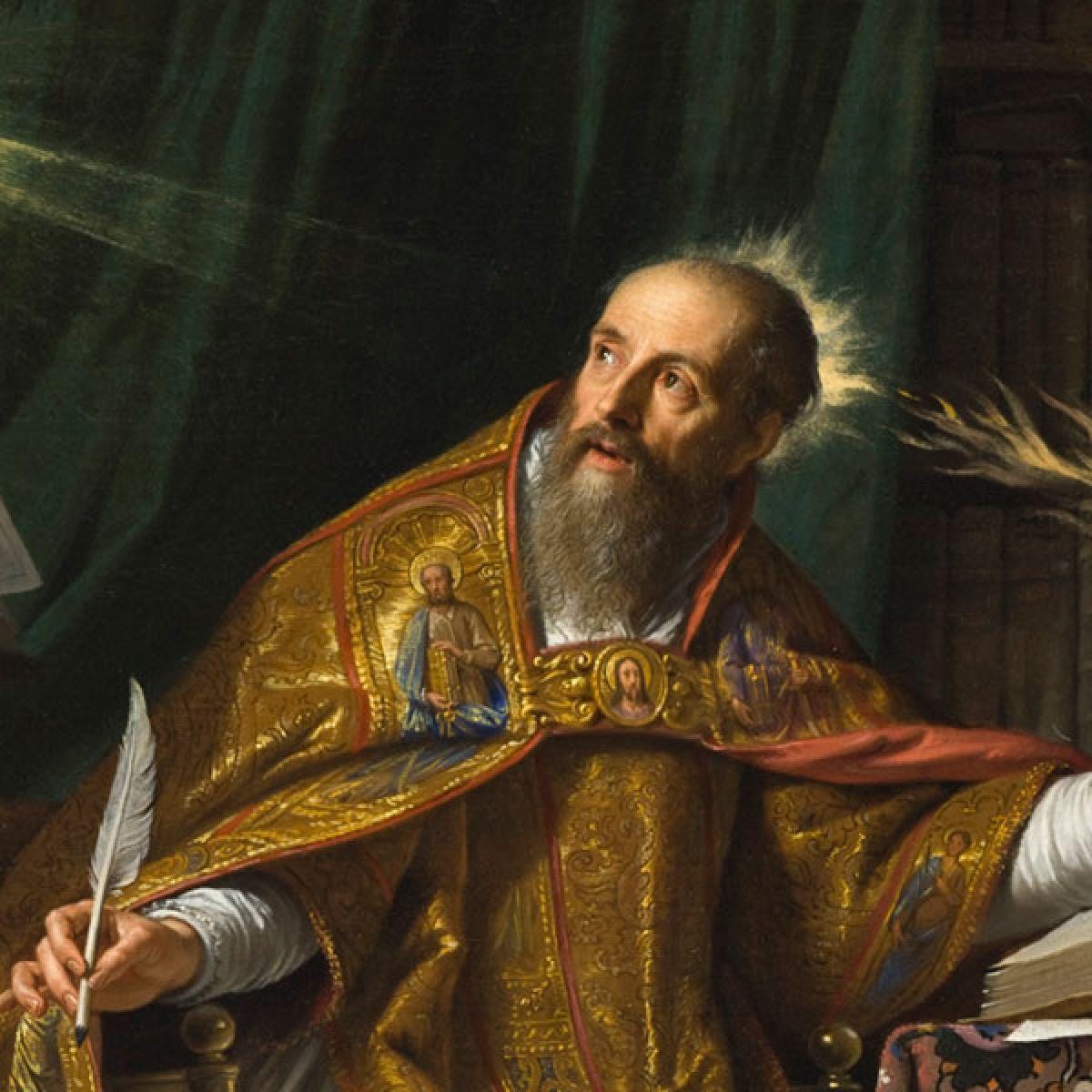
Augustine of Hippo, a city in Roman North Africa, came to the problem in the late 4th century. Augustine reached Christianity via Manichaeism and Neoplatonism. Manichaeism posited an abiding struggle between a world of goodness and light and spirit and a world of evil and darkness and flesh. Neoplatonism applied the Greek tools of logic and deduction to eternal questions of existence.
As a young man, Augustine felt the Manichaean struggle personally. His soul reached for the higher realm but his body lusted for the pleasures of sex. His body usually won, but his soul wouldn't let his body enjoy the victory.
His conversion to Christianity in his early thirties gave him a new way of conceiving his struggle, which he extrapolated to humans generally. Augustine described two cities: the City of God and the Earthly City. Humans lived in the latter but tried to ascend to the former.
They were weighed down by original sin. Augustine was hardly the first person to write about humanity’s fall from a primal paradise. The theme was a staple of origin stories. And of course it's the plot pivot of the book of Genesis and therefore a Christian inheritance from Judaism.
But Augustine, with the logical rigor he drew from Neoplatonism, made original sin a centerpiece of a new Christian theology. The original sin was the disobedience of Adam and Eve in eating the fruit of the tree of the knowledge of good and evil, against God’s explicit decree. This was often linked to the sin of pride, in that Adam and Eve tried to make themselves equal to God by knowing what he knew.
For their sin they were cast out of paradise and condemned to suffer hunger, pain and all the insults life inflicts on humans. The main point, for Augustine, was that humans had brought this on themselves.
Not only that, the sin was passed from generation to generation. Why? Because each generation was born in sin — or, more precisely, conceived in sin, by the sex act. Augustine never got over his Manichaean conviction that sex was base and evil. And like many other males throughout history, he blamed women for the sexual power they held over men. Eve had tempted Adam in the garden, and women had been tempting men ever since.
Augustine’s version of original sin took the Christian world by storm, becoming a tenet of Christian theology that hasn't changed much until today.
Its success had two causes. One was Augustine’s intellectual brilliance and argumentative power. None could match him in debate then, and few have come close since.
The other cause was the cooptability of such a doctrine by a church hierarchy seeking to lock believers into a condition of dependence and loyalty. The Augustinian version of original sin set the default for the fate of humans at hellfire and damnation. Individual men and women might never sin themselves, yet they were still condemned for eternity — unless they followed the teachings and practices of the Christian church as established by the popes and their advisers.
Augustine's interpretation of original sin came at a timely moment in the history of Christianity. Much earlier, while Christianity remained an outlaw sect, his doctrine would have been too off-putting. Groups seeking recruits don't do well scaring the daylights out of them.
More to the point, the embrace of Augustine's original sin was a power move by a Christianity recently adopted as the faith of the Roman empire. Official Rome held the power of life and death over the bodies of those within its reach. Official Christianity asserted the power of life and death over their souls. Original sin guaranteed that there was no escape. You played by the rules of the church or you went to hell.
The strategy worked astonishingly well. For more than a thousand years, the church of Rome held sway over Western Europe. Not until the Protestant Reformation of the 16th century was its authority materially challenged. And even then, Martin Luther and the other reformers broadly accepted the Augustinian view of original sin.
The formula was too effective to be abandoned.
Plato abandoned actual logic with his dualism in which the non-material world forms true reality. This same mindset is imbedded in Hinduism as well as Mary Baker Eddy's Christian Science religion (I actually read her entire Science and Health - her "Book of Mormon"if you will- because I was dating a young woman at the time that was an adherent).
Aristotle was much more straight up logic and reality based as a philosopher, IMO.
The mysoginy in Christianity runs deep and Augustine embodies it quite explicitly. Never mind that without sex there'd be no humanity to BE Christians.
As to some/most versions of Christianity accepting much of the Bible as metaphor, the devout I have had conversations with do believe that EXCEPT for two key tenets. They cannot accept the Virgin Birth as a metaphor nor the Resurrection. They can toss all other miracles and supernatural happenings as metaphorical except those two occurances.
Ultimately Original Sin is a great racket to keep people under your domination. I am glad I am an atheist.
If sin could be “healed” if we were to evolve, you would think that the results of sin would be eradicated. I don’t see that happening.