Longstreet’s question
Rethinking the route to war

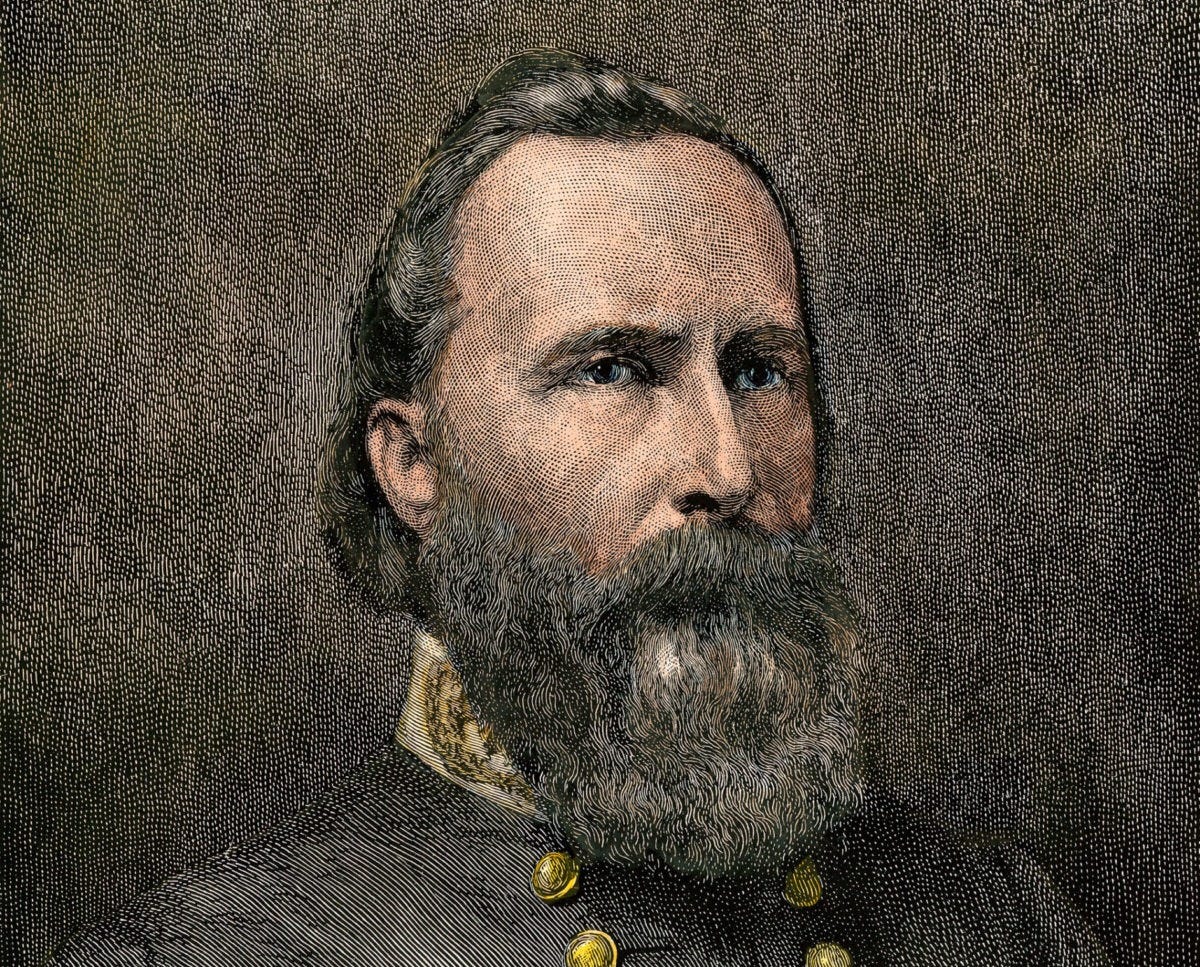
James Longstreet knew Ulysses Grant as a fellow cadet at West Point in the early 1840s and a comrade in the army after graduation. They were stationed in Louisiana and Texas, and they often played a card game called brag to pass the time. Grant wasn’t a good player and typically lost to Longstreet. Grant left the service in the 1850s and pursued other work, not successfully. He reentered the Union army upon the outbreak of the Civil War. Longstreet, born in South Carolina and reared in Georgia, served with the Confederacy.
“The next time we met was at Appomattox,” Longstreet remembered decades later, referring to the Confederate surrender in 1865. “And the first thing that General Grant said to me when we stepped inside, placing his arm in mine, was: ‘Pete (a sobriquet of mine), let us have another game of brag, to recall the old days which were so pleasant to us all.’ Great God! thought I to myself, how my heart swells out to such a magnanimous touch of humanity! Why do men fight who were born to be brothers?”
Why indeed?
The question of why men fight is as old as war itself. The answers are various, but one aspect of the decision process is striking and consistent. To wit: the people who make the decision for war are almost never the same people who fight the war.
Ancient hunters fought over hunting grounds, but recognizably modern war awaited the emergence of states and governments following the development of agriculture and the surpluses it allowed. Since then, one group of people, typically older men, have dominated the positions of political power. On many occasions, from one cause or another, the rulers in one country decide their country should go to war against another country. At this point they turn to a different group, almost always young men, and entreat or order the young men to go fight. With rare exceptions, the young men take up arms and go.
An obvious response to this observation is to ask what would happen if the war-deciders and the war-fighters were the same group. James Longstreet and Ulysses Grant weren't of the political class that chose war in 1861. Jefferson Davis and Abraham Lincoln weren't of the military class that fought the war they chose. Would things have happened differently if Longstreet and Grant had been in on the decision for war, and if Davis and Lincoln had known they would be in the front lines of any war they brought on?
Maybe not. The Civil War was long in the making, and combatants on both sides went into battle with their eyes open. Yet a reasonable prospect of being among the casualties might have tempered the enthusiasm of the political leaders to push their differences to the point of war.
Other wars could well have been less likely if the deciders were also the fighters. Such elective American wars as those in Korea, Iraq and Afghanistan would have been weighed more carefully and quite possibly rejected.
Which is the point of this thought experiment. Armies historically have consisted of young because those strapping fellows are better fighters than their elders. This isn't going to change.
Yet if the elders merely imagined themselves at the front, at least some needless wars might be averted.
In America, various people have suggested a step in that direction, in the form of a restoration of the draft. The all-volunteer army America has mustered since Vietnam is largely segregated by class from the governing class. Not only do legislators not serve, neither do members of their families. Restoration of the draft could reverse this shift by putting family skin back in the game.
If nothing else, reviving the draft might shorten America's wars. The Afghanistan war was the longest in American history, in no small part because few people protested its length. And this because, unlike during the Vietnam war, the army during the Afghanistan war didn't dragoon soldiers to fight there.
Longstreet's question—why do men fight?—isn’t answered easily. But bringing war closer to those who decide for or against it might make affirmative answers harder.
Longstreet was best man at Grant’s wedding before the war. He also served under grant after the war and became a republican. He led African-American militia in Georgia against White Southerners fighting reconstruction. quite a turnaround.
Civilian control of the military is a good thing actually...