Imagine that
Benedict Anderson theorizes nationalism

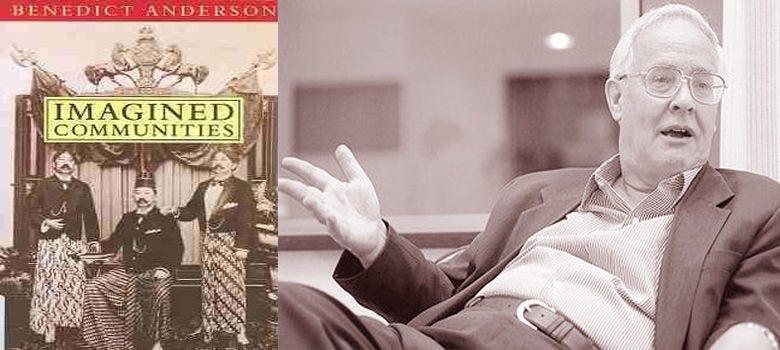
Capitalism had Adam Smith. Communism had Karl Marx. Liberalism had John Locke and John Stuart Mill. Conservatism had Edmund Burke.
Benedict Anderson thought nationalism needed a comparable theorist. He nominated himself.
Anderson was born in China in 1936 to parents of English and Irish descent. The family fled to America during World War II and settled in Ireland afterward. Anderson studied classics at Cambridge before earning a doctorate at Cornell University in New York. Cornell had a strong program in Southeast Asian studies, and Anderson specialized in Indonesia, which experienced a brutal convulsion in 1965 that included the overthrow of Sukarno, the left-leaning nationalist who led Indonesia to independence from the Netherlands, and the killing of hundreds of thousands of Indonesian communists by groups supporting Suharto, the general who replaced Sukarno.
Anderson’s critique of the new regime led to his being declared persona non grata. It also piqued his curiosity about nationalism, the belief system behind the wave of decolonization in Asia and Africa during the decades after World War II. Leftists and rightists wrapped themselves in the banner of nationalism, but no one seemed to spend much time thinking about what nationalism really was. Anderson did so, and in 1983 he published Imagined Communities: Reflections on the Origin and Spread of Nationalism.
Understanding nationalism required understanding the idea of the nation. “I propose the following definition of the nation,” Anderson said. “It is an imagined political community—and imagined as both inherently limited and sovereign.”
He elaborated. “It is imagined because the members of even the smallest nation will never know most of their fellow members, meet them, or even hear of them, yet in the minds of each lives the image of their communion.”
“The nation is imagined as limited because even the largest of them, encompassing perhaps a billion human beings, has finite, if elastic, boundaries, beyond which lie other nations. No nation imagines itself coterminus with mankind. The most messianic nationalists do not dream of a day when all the members of the human race will join their nation in the way that it was possible, in certain epochs, for, say, Christians to dream of a wholly Christian planet.”
“It is imagined as sovereign because the concept was born in an age in which Enlightenment and revolution were destroying legitimacy of the divinely ordained, hierarchical dynastic realm.”
“It is imagined as a community, because, regardless of the actual inequality and exploitations that may prevail in each, the nation is always conceived as a deep, horizontal comradeship. Ultimately it is this fraternity that makes it possible, over the past two centuries, for so many millions of people, not so much to kill, as willingly to die for such limited imaginings.”
Before Anderson, nationalism had been described in terms of shared history, lineage, language, religion and other objective markers. Nations consisted of actual people. Imagination had little to do with the matter.
But that older nationalism left people at the mercy of things they couldn’t control. And it held out little hope that the peoples of Asia and Africa, for all their independence, could ever create states as coherent and powerful as those of Europe, North America and East Asia. Indonesia, Anderson’s hope for the future of what then was called the Third World, had more than seven hundred distinct languages, which were spoken by scores of what would have been nations under the old definition.
Recasting nations as imagined communities put people back in charge. If a critical mass of Indonesians imagined that they were a coherent people, they could become one.
Not everyone was persuaded. Old-line nationalists stuck to historical explanations. Marxists dismissed Anderson’s approach as ignoring the dialectical materialism upon which political epiphenomena always rest.
This was a particular problem for Anderson, who identified as a Marxist or fellow traveler. In fact it was the failure of Marxist theory to account for conflicts in the 1970s between Marxist states in Southeast Asia—China against Vietnam, Vietnam against Cambodia—that prompted Anderson’s search for an alternative nationalism.
His thinking enjoyed a vogue and then faded. The older version of nationalism seemed more robust and, to many people, common-sensical.
Yet imagined communities had a second life in the rise of identity politics starting in the late 20th century. Racial minorities that possessed little in common besides not being white could imagine themselves as part of a community of color. Non-heterosexuals could imagine themselves as the LGB+ community. Certain Christian groups wrapped religion and often whiteness into a community of Christian nationalism.
The attraction of Anderson’s approach was the legitimacy it conferred on the imagined communities. By the time Anderson arrived at the nationalism debate, nations had become the elementary particles of international politics, enshrined in the name and tenets of the United Nations. Any group that could credibly describe itself as a nation had a moral claim on the world’s conscience. The new communities of identity wanted this, and sometimes got it.
The vogue of identity hasn’t gone away. Anderson’s imagination gave it staying power.
Masterful historiographical essay. I'll be restacking this one next week. Anderson's theory always struck me as onto something important. Thanks HWB!