
The ancient Greeks were better at mathematical theory than mathematical practice. This was partly the doing of Plato and other seekers of eternal truths that transcended mundane reality. But it was also because their methods of handling numbers, essential to applications, were cumbersome.
Roman numbers weren’t much better. Despite this, the Romans were first-rate engineers. They simply applied themselves to practical problems more assiduously than the Greeks had. And the temples and aqueducts the Romans built didn’t require enormous precision.
It wasn’t until the end of the first millennium that the situation in the West improved. Traveling merchants brought recognizably modern numerals from India via Arab countries. This Hindu-Arabic system had ten digits, place values and zero. Conservatives in Italy and other Western countries tried to outlaw it, clinging to the Roman system. But efficiency eventually won, and the modern system took hold.
Yet even as the new system allowed faster calculations, its very efficiency inspired practical mathematicians to assign it more complicated tasks. Among these were predictions of the movements of planets, which required calculations that ran to several decimal places. The myriad multiplications, divisions, square roots and other manipulations could keep regiments of calculators occupied.
But in the early 17th century, a Scotsman named John Napier and an Englishman called William Oughtred combined to lighten the work of calculators. In doing so they made possible the scientific revolution, which lightened the work of everyone else.
Napier’s innovation was the logarithm, a term he coined from the Greek logos (which can mean ratio) and arithmos (number). Logarithms provided a way of representing numbers in terms of the exponents or powers of some fixed base number. Thus 1,000, which is 10 to the 3rd power, is represented by 3. And 1,000,000, which is 10 to the 6th power, is represented by 6.
The advantage of logarithms appears when two numbers are multiplied. 1,000 times 1,000,000 equals 1,000,000,000. In terms of powers, 10 to the 3rd power times 10 to the 6th power equals 10 to the 9th power. Note that the multiplication of the original numbers corresponds to addition of the logarithms.
This is generally true. And it applies as well when the logarithms aren’t whole numbers but fractions, and when they are negative, corresponding to reciprocals.
Addition is typically easier than multiplication. Thus Napier’s invention of logarithms facilitated the labor of the overworked calculators.
William Oughtred facilitated it even more. Oughtred recognized that addition can be done mechanically. I can add 3 and 6 by laying a stick of length 6 at the end of a stick of length 3, and then observing or measuring the total length.
The same result appears when I lay two marked sticks or rulers side by side, one above the other. I slide the upper ruler so that its starting point aligns with the 3 on the lower ruler. Then I observe where the 6 on the upper ruler lies. It aligns with the 9 on the lower ruler. This is my sum.
Oughtred’s bright idea was to mark the sliding rulers not with 3, 6 and 9 in this case, but with 1,000, 1,000,000 and 1,000,000,000. By this means the sliding rulers performed multiplication.
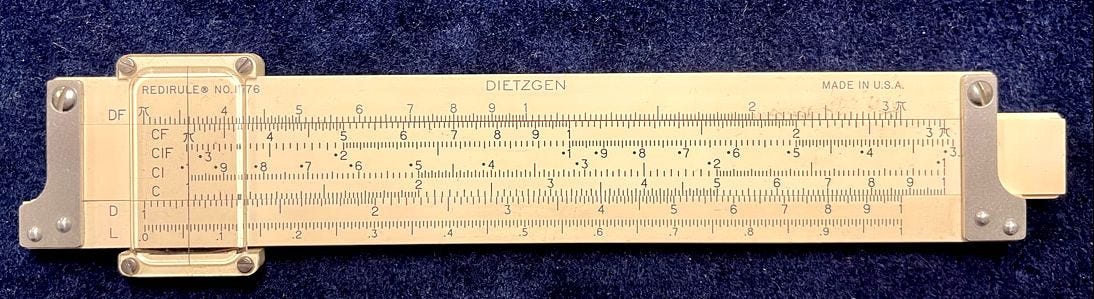
Oughtred’s sliding rulers came to be called a slide rule. Improved and elaborated over time, it converted multiplication, division and other complicated operations into simpler addition and subtraction, without the user having to think about the conversion.
Slide rules made possible Isaac Newton’s discovery of the law of universal gravitation in the late 17th century. Slide rules helped James Watt improve the steam engine in the 18th century. Slide rules built railroads and reckoned steamship routes in the 19th century. Slide rules let Albert Einstein check his law of special relativity in the early 20th century. Thomas Edison never left home without his slide rule. The Wall Street of J. P. Morgan would have seized up without its slide rules. Radio and television would have been impossible. Slide rules got aircraft off the ground. They built the atom bomb and put men on the moon.
Slide rules were often faster than mechanical calculators. Electronic computers could do heavier lifting starting in the 1940s, but they were few and expensive. Scientists and engineers routinely carried slide rules through the 1960s. Not till Hewlett Packard introduced the HP-35 in 1972 did electronic calculators supplant slide rules in the workplace.
Some really basic tools have been around forever. A hammer is still a hammer, even if nail guns eat their lunch on construction sites.
But slide rules were technically sophisticated. The fact that they ruled the world of calculation for three and a half centuries is testament to the power of the ideas behind them: Napier’s logarithms and Oughtred’s sliding sticks.
Great article it reminded me of a book I was recently reading called “Empire of the sum: the rise and reign of the pocket calculator” by Keith Houston . Two interesting tidbits about the slide rule I always thought were cool. “The E6b slide rule appeared in Star Trek more than once, a retro futuristic anachronism in Mr. Spock’s scientific toolkit and it is still in use for training pilots a century after its invention.”
“It is not known whether Neil Armstrong or buzz aldrin ever had to break out their slide rules while aboard the Apollo but that did not stop aldrin’s rule from fetching $77,675 at auction in 2007.”
I hope that somewhere someone is still producing these marvels - we'll need them again when civilization collapses and our electrical grid along with it.